距离查询
Open3D 中的 RaycastingScene 类提供了一组距离查询功能,可用于将三角网格转换为隐式函数、查询到表面的距离,或判断某个点是否位于网格内部。
本教程展示如何生成这些查询,并从网格生成几何处理与三维机器学习中常用的各种隐式表示。
将网格转换为隐式表示
Section titled “将网格转换为隐式表示”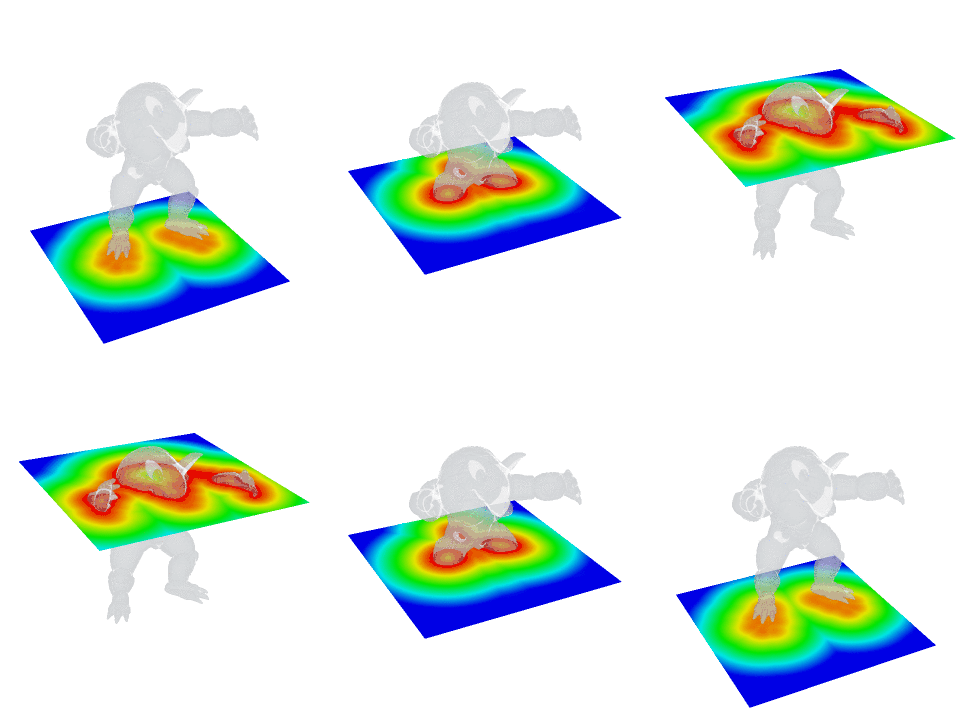
第一步,用一个(闭合的)三角网格初始化 RaycastingScene:
# Load mesh and convert to open3d.t.geometry.TriangleMesharmadillo_data = o3d.data.ArmadilloMesh()mesh = o3d.io.read_triangle_mesh(armadillo_data.path)mesh = o3d.t.geometry.TriangleMesh.from_legacy(mesh)
# Create a scene and add the triangle meshscene = o3d.t.geometry.RaycastingScene()_ = scene.add_triangles(mesh)  # we do not need the geometry ID for mesh
计算单个点的距离与占据状态
Section titled “计算单个点的距离与占据状态”RaycastingScene 直接提供了若干函数,用于计算从一个点到网格表面的无符号距离和有符号距离,还提供了一个用于计算查询点占据状态(occupancy)的函数。
query_point = o3d.core.Tensor([[10, 10, 10]], dtype=o3d.core.Dtype.Float32)
# Compute distance of the query point from the surfaceunsigned_distance = scene.compute_distance(query_point)signed_distance = scene.compute_signed_distance(query_point)occupancy = scene.compute_occupancy(query_point)
无符号距离始终可以计算,而有符号距离和占据状态只有在网格是水密(watertight)的、且内部与外部有明确定义时才有效。如果查询点位于网格内部,则有符号距离为负值。占据状态在点位于网格外部时为 0,位于内部时为 1。
在本例中,网格是水密的,从有符号距离和占据状态的值可以看出查询点位于网格内部。
print("unsigned distance", unsigned_distance.numpy())print("signed_distance", signed_distance.numpy())print("occupancy", occupancy.numpy())输出:
unsigned distance [7.8694816]signed_distance [-7.8694816]occupancy [1.]计算多个点和网格的距离
Section titled “计算多个点和网格的距离”RaycastingScene 支持一次性进行多次查询。例如,我们可以传入一个 [N,3] 的 Tensor,包含 N 个查询点,这可用于在机器学习中随机采样一个体积,以训练隐式神经表示。
min_bound = mesh.vertex.positions.min(0).numpy()max_bound = mesh.vertex.positions.max(0).numpy()
N = 256query_points = np.random.uniform(low=min_bound, high=max_bound,                                 size=[N, 3]).astype(np.float32)
# Compute the signed distance for N random pointssigned_distance = scene.compute_signed_distance(query_points)
RaycastingScene 允许以任意数量的前导维度来组织查询点。要查询一个网格的有符号距离,可以这样做:
xyz_range = np.linspace(min_bound, max_bound, num=32)
# query_points is a [32,32,32,3] array ..query_points = np.stack(np.meshgrid(*xyz_range.T), axis=-1).astype(np.float32)
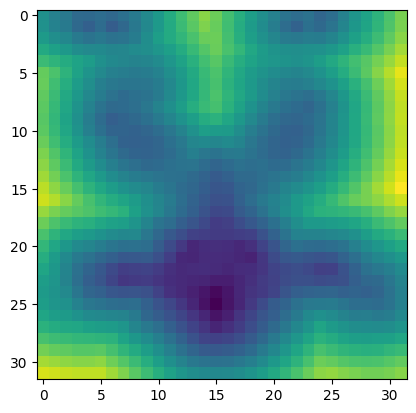
# signed distance is a [32,32,32] arraysigned_distance = scene.compute_signed_distance(query_points)
# We can visualize a slice of the distance field directly with matplotlibplt.imshow(signed_distance.numpy()[:, :, 15])
同样的流程也适用于 RaycastingScene.compute_distance 和 RaycastingScene.compute_occupancy,可用于生成无符号距离场和占据场。
基于最近点查询计算距离
Section titled “基于最近点查询计算距离”距离函数是建立在 compute_closest_points() 函数之上的。本部分将重新实现有符号距离的计算,并展示如何利用 compute_closest_points() 函数返回的额外信息。
首先用两个三角网格初始化一个 RaycastingScene。两个网格都是水密的,并且我们将它们放置为彼此不相交。
cube = o3d.t.geometry.TriangleMesh.from_legacy(    o3d.geometry.TriangleMesh.create_box().translate([-1.2, -1.2, 0]))sphere = o3d.t.geometry.TriangleMesh.from_legacy(    o3d.geometry.TriangleMesh.create_sphere(0.5).translate([0.7, 0.8, 0]))
scene = o3d.t.geometry.RaycastingScene()# Add triangle meshes and remember idsmesh_ids = {}mesh_ids[scene.add_triangles(cube)] = 'cube'mesh_ids[scene.add_triangles(sphere)] = 'sphere'
计算表面上的最近点
Section titled “计算表面上的最近点”RaycastingScene.compute_closest_points() 可以计算相对于查询点的表面上最近点。
query_point = o3d.core.Tensor([[0, 0, 0]], dtype=o3d.core.Dtype.Float32)
# We compute the closest point on the surface for the point at position [0,0,0].ans = scene.compute_closest_points(query_point)
# Compute_closest_points provides the point on the surface, the geometry id,# and the primitive id.# The dictionary keys are#.    points#.    geometry_ids#.    primitive_idsprint('The closest point on the surface is', ans['points'].numpy())print('The closest point is on the surface of the',      mesh_ids[ans['geometry_ids'][0].item()])print('The closest point belongs to triangle', ans['primitive_ids'][0].item())
输出:
The closest point on the surface is [[-0.2 -0.2 0. ]]The closest point is on the surface of the cubeThe closest point belongs to triangle 0要判断点位于内部还是外部,可以从查询点出发投射一条射线,并统计交点数量:
rays = np.concatenate( [query_point.numpy(), np.ones(query_point.shape, dtype=np.float32)], axis=-1)intersection_counts = scene.count_intersections(rays).numpy()# A point is inside if the number of intersections with the scene is even# This assumes that inside and outside are well-defined for the scene.is_inside = intersection_counts % 2 == 1我们可以把这些步骤组合成一个函数,从而创建一个返回额外信息的特殊有符号距离函数:
def compute_signed_distance_and_closest_goemetry(query_points: np.ndarray): closest_points = scene.compute_closest_points(query_points) distance = np.linalg.norm(query_points - closest_points['points'].numpy(), axis=-1) rays = np.concatenate([query_points, np.ones_like(query_points)], axis=-1) intersection_counts = scene.count_intersections(rays).numpy() is_inside = intersection_counts % 2 == 1 distance[is_inside] *= -1 return distance, closest_points['geometry_ids'].numpy()我们可以用这个函数生成一个包含距离和几何体 id 信息的网格:
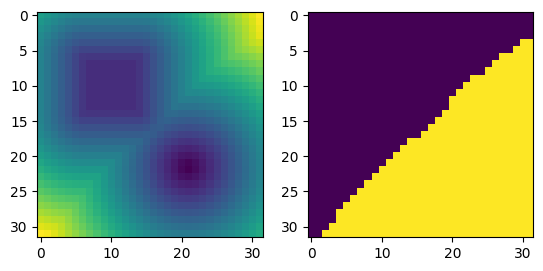
# compute rangexyz_range = np.linspace([-2, -2, -2], [2, 2, 2], num=32)# query_points is a [32,32,32,3] array ..query_points = np.stack(np.meshgrid(*xyz_range.T), axis=-1).astype(np.float32)
sdf, closest_geom = compute_signed_distance_and_closest_goemetry(query_points)
# We can visualize a slice of the grids directly with matplotlibfig, axes = plt.subplots(1, 2)axes[0].imshow(sdf[:, :, 16])axes[1].imshow(closest_geom[:, :, 16])