
全局配准
ICP 配准与彩色点云配准都属于局部配准(local registration)方法,因为它们都需要一个粗略对齐作为初始化。本教程介绍另一类配准方法——全局配准(global registration)。这类算法不需要任何初始对齐作为初始化,通常得到的结果不如局部方法紧密,因而常被用作局部方法的初始化。
下面的辅助函数将变换后的源点云与目标点云一起可视化:
def draw_registration_result(source, target, transformation): source_temp = copy.deepcopy(source) target_temp = copy.deepcopy(target) source_temp.paint_uniform_color([1, 0.706, 0]) target_temp.paint_uniform_color([0, 0.651, 0.929]) source_temp.transform(transformation) o3d.visualization.draw_geometries([source_temp, target_temp], zoom=0.4559, front=[0.6452, -0.3036, -0.7011], lookat=[1.9892, 2.0208, 1.8945], up=[-0.2779, -0.9482, 0.1556])提取几何特征
Section titled “提取几何特征”我们对点云进行下采样、估计法向量,然后为每个点计算 FPFH 特征。FPFH 特征是一个 33 维向量,描述了一个点的局部几何属性。在 33 维空间中进行最近邻查询,即可返回具有相似局部几何结构的点。详见 [Rasu2009]。
def preprocess_point_cloud(pcd, voxel_size):    print(":: Downsample with a voxel size %.3f." % voxel_size)    pcd_down = pcd.voxel_down_sample(voxel_size)
    radius_normal = voxel_size * 2    print(":: Estimate normal with search radius %.3f." % radius_normal)    pcd_down.estimate_normals(        o3d.geometry.KDTreeSearchParamHybrid(radius=radius_normal, max_nn=30))
radius_feature = voxel_size * 5 print(":: Compute FPFH feature with search radius %.3f." % radius_feature) pcd_fpfh = o3d.pipelines.registration.compute_fpfh_feature( pcd_down, o3d.geometry.KDTreeSearchParamHybrid(radius=radius_feature, max_nn=100)) return pcd_down, pcd_fpfh下面的代码从两个文件中分别读取源点云和目标点云。它们以单位矩阵作为变换,处于未对齐状态。
def prepare_dataset(voxel_size):    print(":: Load two point clouds and disturb initial pose.")
    demo_icp_pcds = o3d.data.DemoICPPointClouds()    source = o3d.io.read_point_cloud(demo_icp_pcds.paths[0])    target = o3d.io.read_point_cloud(demo_icp_pcds.paths[1])    trans_init = np.asarray([[0.0, 0.0, 1.0, 0.0], [1.0, 0.0, 0.0, 0.0],                             [0.0, 1.0, 0.0, 0.0], [0.0, 0.0, 0.0, 1.0]])    source.transform(trans_init)    draw_registration_result(source, target, np.identity(4))
    source_down, source_fpfh = preprocess_point_cloud(source, voxel_size)    target_down, target_fpfh = preprocess_point_cloud(target, voxel_size)    return source, target, source_down, target_down, source_fpfh, target_fpfh
voxel_size = 0.05 # means 5cm for this datasetsource, target, source_down, target_down, source_fpfh, target_fpfh = prepare_dataset( voxel_size)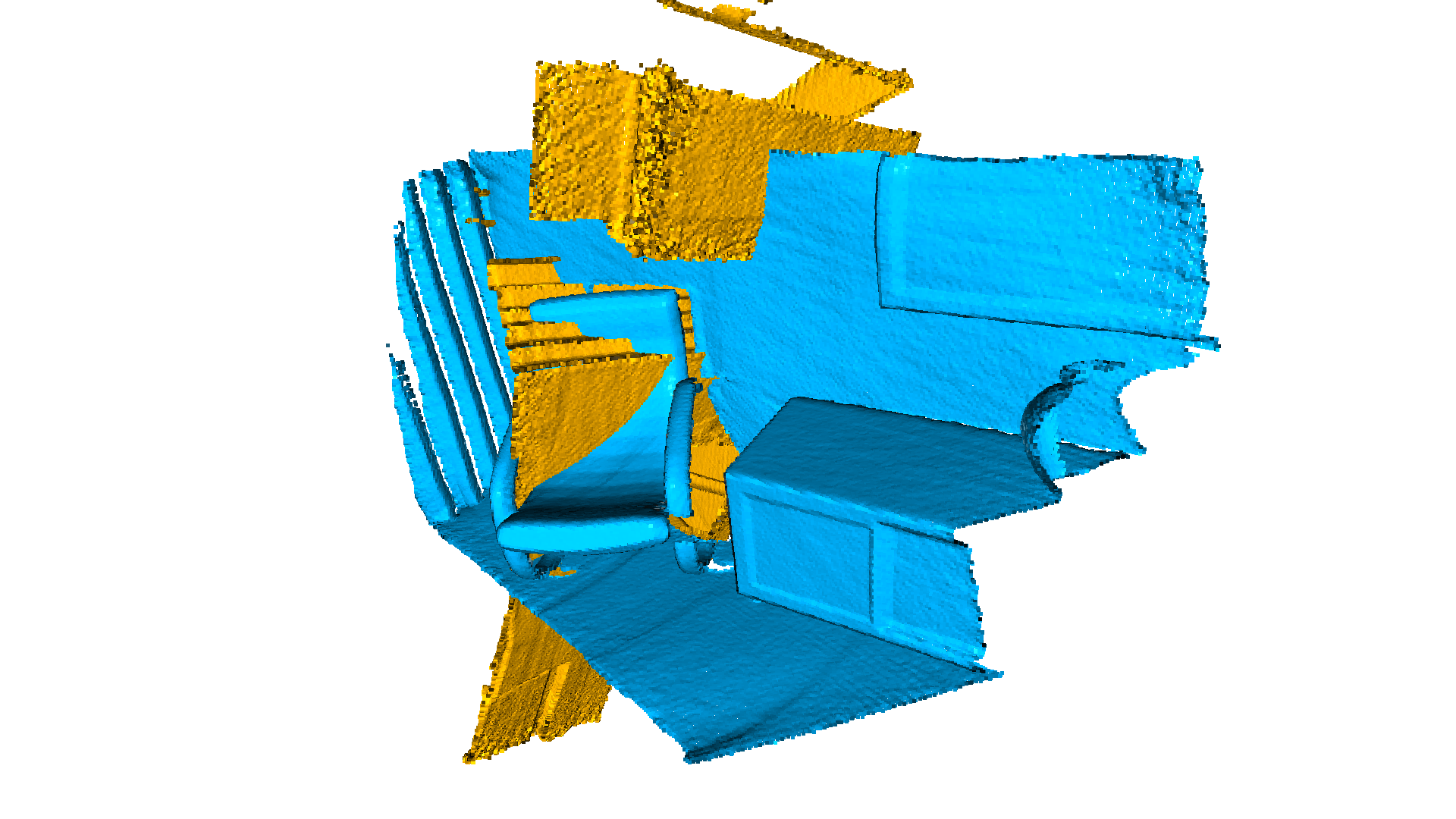
输出:
:: Load two point clouds and disturb initial pose.[Open3D WARNING] GLFW Error: Failed to detect any supported platform[Open3D WARNING] GLFW initialized for headless rendering.:: Downsample with a voxel size 0.050.:: Estimate normal with search radius 0.100.:: Compute FPFH feature with search radius 0.250.:: Downsample with a voxel size 0.050.:: Estimate normal with search radius 0.100.:: Compute FPFH feature with search radius 0.250.RANSAC
Section titled “RANSAC”我们使用 RANSAC 进行全局配准。在每一次 RANSAC 迭代中,从源点云中随机选取 ransac_n 个点,通过在 33 维 FPFH 特征空间中查询最近邻来找到它们在目标点云中的对应点。随后是一个剪枝(pruning)步骤,利用快速剪枝算法尽早剔除错误的匹配。
Open3D 提供如下剪枝算法:
CorrespondenceCheckerBasedOnDistance检查对齐后的点云是否足够接近(小于给定阈值)。CorrespondenceCheckerBasedOnEdgeLength检查分别从源和目标对应关系中任意取出的两条边(由两个顶点连成的线段)的长度是否相似。本教程验证 与 是否同时成立。CorrespondenceCheckerBasedOnNormal考量任意对应关系的顶点法向量亲和性。它计算两个法向量的点积,阈值以弧度值给出。
只有通过剪枝步骤的匹配才会用于计算变换,并在整个点云上进行验证。核心函数是 registration_ransac_based_on_feature_matching。该函数最重要的超参数是 RANSACConvergenceCriteria,它定义了 RANSAC 的最大迭代次数与置信概率。这两个数值越大,结果越精确,但算法耗时也越长。
我们依据 [Choi2015] 给出的经验值来设置 RANSAC 参数。
def execute_global_registration(source_down, target_down, source_fpfh, target_fpfh, voxel_size): distance_threshold = voxel_size * 1.5 print(":: RANSAC registration on downsampled point clouds.") print(" Since the downsampling voxel size is %.3f," % voxel_size) print(" we use a liberal distance threshold %.3f." % distance_threshold) result = o3d.pipelines.registration.registration_ransac_based_on_feature_matching( source_down, target_down, source_fpfh, target_fpfh, True, distance_threshold, o3d.pipelines.registration.TransformationEstimationPointToPoint(False), 3, [ o3d.pipelines.registration.CorrespondenceCheckerBasedOnEdgeLength( 0.9), o3d.pipelines.registration.CorrespondenceCheckerBasedOnDistance( distance_threshold) ], o3d.pipelines.registration.RANSACConvergenceCriteria(100000, 0.999)) return resultresult_ransac = execute_global_registration(source_down, target_down, source_fpfh, target_fpfh, voxel_size)print(result_ransac)draw_registration_result(source_down, target_down, result_ransac.transformation)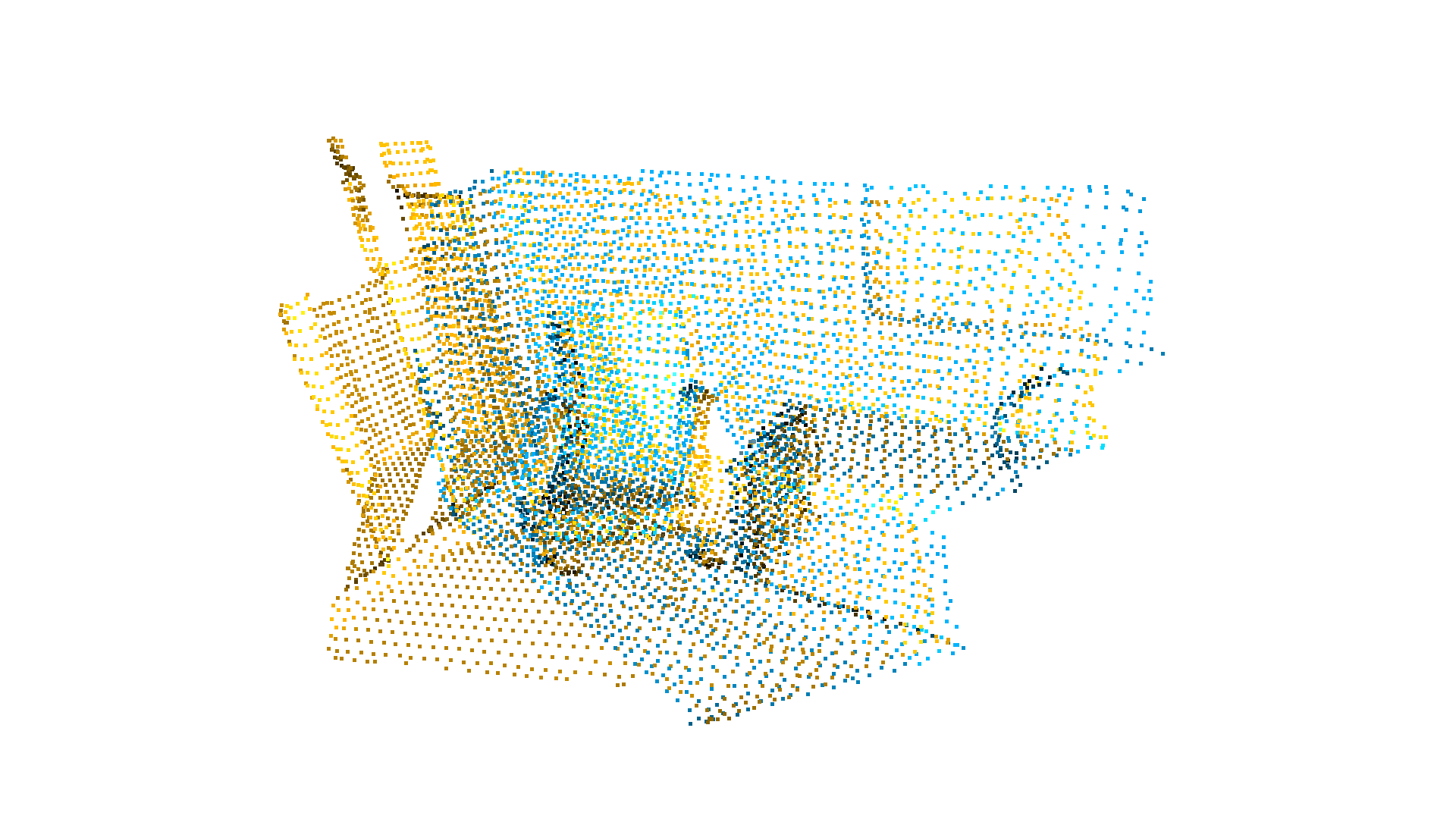
输出:
:: RANSAC registration on downsampled point clouds. Since the downsampling voxel size is 0.050, we use a liberal distance threshold 0.075.RegistrationResult with fitness 0.6xxxxxx and correspondence_set size of 3204Access transformation to get result.[Open3D WARNING] GLFW initialized for headless rendering.出于性能考虑,全局配准仅在大幅下采样后的点云上进行,结果也并不紧密。我们使用 Point-to-plane ICP 进一步精细化对齐。
def refine_registration(source, target, source_fpfh, target_fpfh, voxel_size): distance_threshold = voxel_size * 0.4 print(":: Point-to-plane ICP registration is applied on original point") print(" clouds to refine the alignment. This time we use a strict") print(" distance threshold %.3f." % distance_threshold) result = o3d.pipelines.registration.registration_icp( source, target, distance_threshold, result_ransac.transformation, o3d.pipelines.registration.TransformationEstimationPointToPlane()) return resultresult_icp = refine_registration(source, target, source_fpfh, target_fpfh, voxel_size)print(result_icp)draw_registration_result(source, target, result_icp.transformation)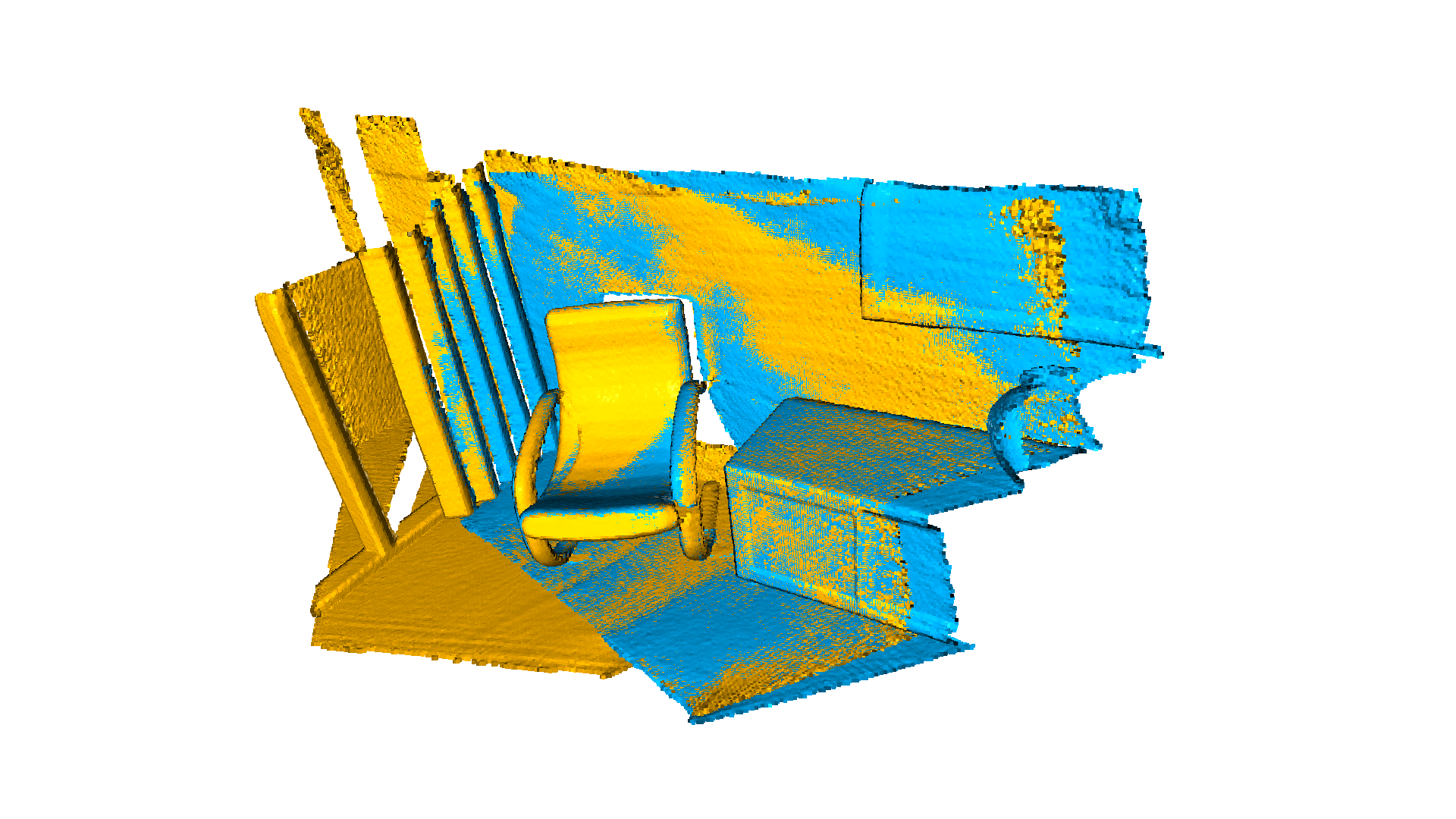
输出:
:: Point-to-plane ICP registration is applied on original point clouds to refine the alignment. This time we use a strict distance threshold 0.020.RegistrationResult with fitness 0.9xxxxxx and correspondence_set size of 123483Access transformation to get result.[Open3D WARNING] GLFW initialized for headless rendering.快速全局配准
Section titled “快速全局配准”基于 RANSAC 的全局配准方案,由于需要进行大量模型提议与评估,可能会耗费较长时间。[Zhou2016] 提出了一种更快的方法,能够快速优化少量对应关系的线过程(line process)权重。由于每次迭代都不涉及模型提议与评估,[Zhou2016] 所提方法可节省大量计算时间。
本教程将基于 RANSAC 的全局配准运行时间与 [Zhou2016] 的实现进行对比。
我们使用与上面全局配准示例相同的输入。
voxel_size = 0.05 # means 5cm for the datasetsource, target, source_down, target_down, source_fpfh, target_fpfh = \ prepare_dataset(voxel_size)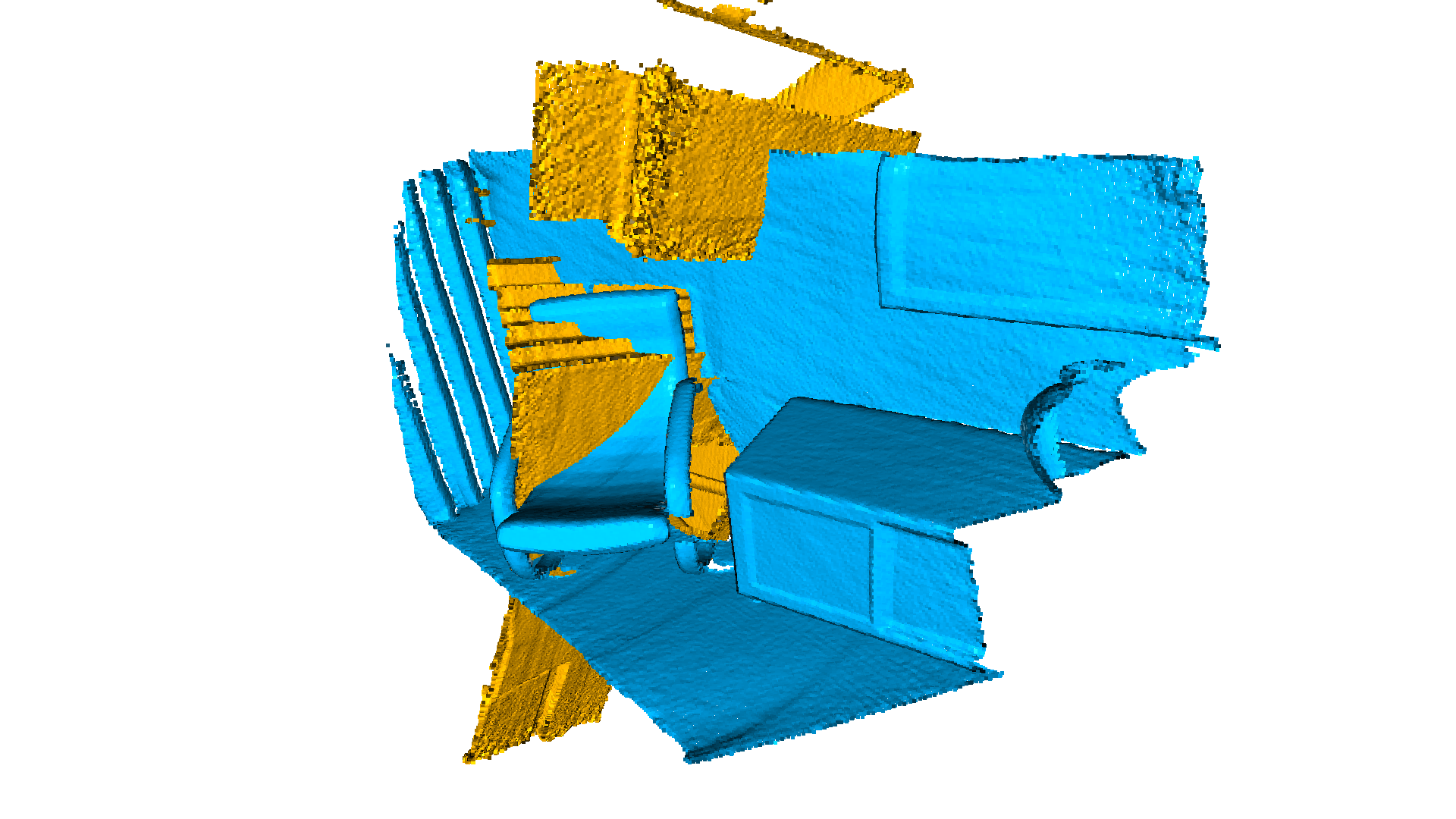
输出:
:: Load two point clouds and disturb initial pose.[Open3D WARNING] GLFW initialized for headless rendering.:: Downsample with a voxel size 0.050.:: Estimate normal with search radius 0.100.:: Compute FPFH feature with search radius 0.250.:: Downsample with a voxel size 0.050.:: Estimate normal with search radius 0.100.:: Compute FPFH feature with search radius 0.250.下面的代码对全局配准方法计时。
start = time.time()result_ransac = execute_global_registration(source_down, target_down, source_fpfh, target_fpfh, voxel_size)print("Global registration took %.3f sec.\n" % (time.time() - start))print(result_ransac)draw_registration_result(source_down, target_down, result_ransac.transformation)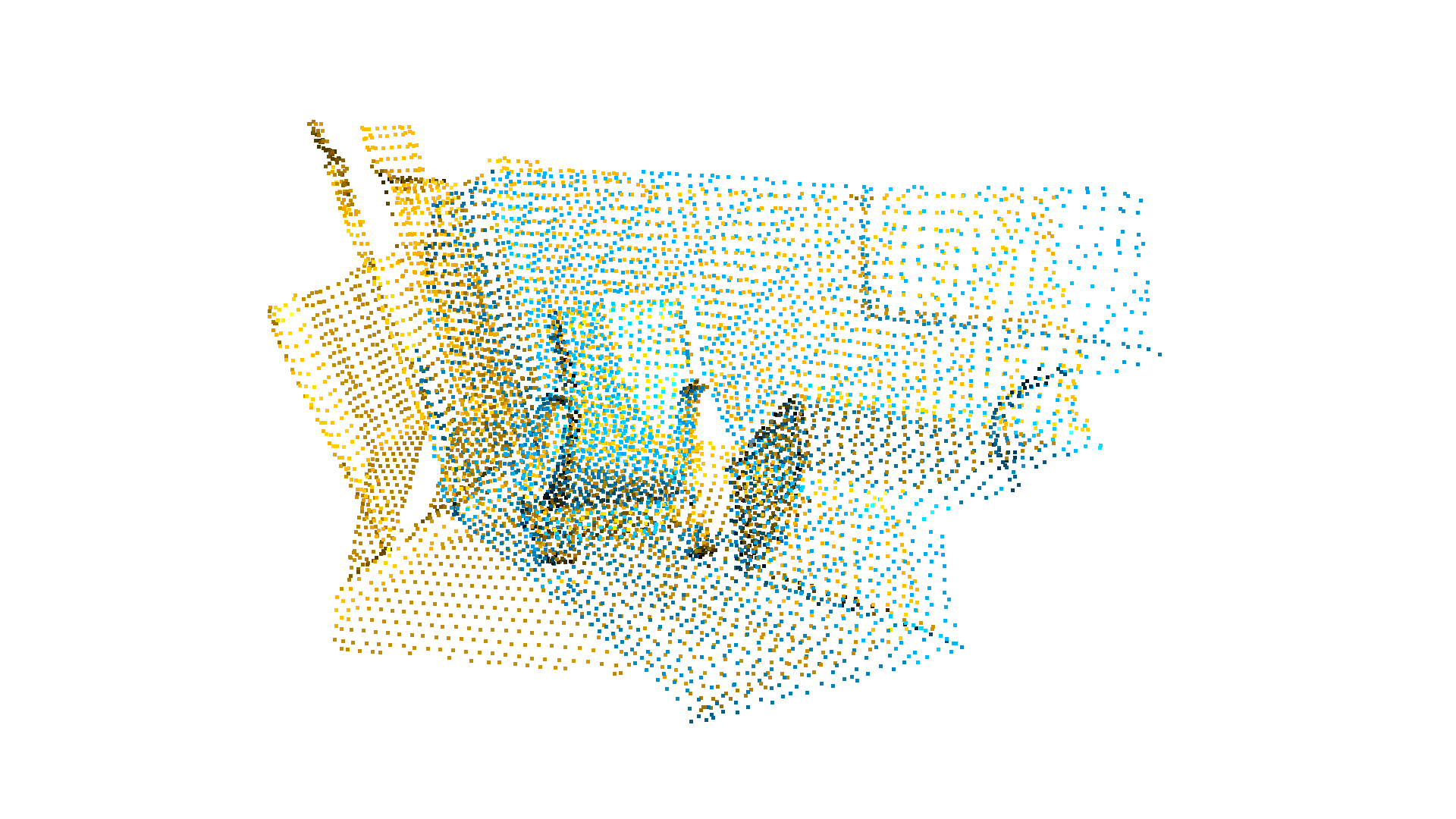
输出:
:: RANSAC registration on downsampled point clouds.   Since the downsampling voxel size is 0.050,   we use a liberal distance threshold 0.075.Global registration took 0.112 sec.
RegistrationResult with fitness 0.7xxxxxx and correspondence_set size of 3200Access transformation to get result.[Open3D WARNING] GLFW initialized for headless rendering.
快速全局配准
Section titled “快速全局配准”使用与基线相同的输入,下面的代码调用 [Zhou2016] 的实现。
def execute_fast_global_registration(source_down, target_down, source_fpfh, target_fpfh, voxel_size): distance_threshold = voxel_size * 0.5 print(":: Apply fast global registration with distance threshold %.3f" \ % distance_threshold) result = o3d.pipelines.registration.registration_fgr_based_on_feature_matching( source_down, target_down, source_fpfh, target_fpfh, o3d.pipelines.registration.FastGlobalRegistrationOption( maximum_correspondence_distance=distance_threshold)) return resultstart = time.time()result_fast = execute_fast_global_registration(source_down, target_down, source_fpfh, target_fpfh, voxel_size)print("Fast global registration took %.3f sec.\n" % (time.time() - start))print(result_fast)draw_registration_result(source_down, target_down, result_fast.transformation)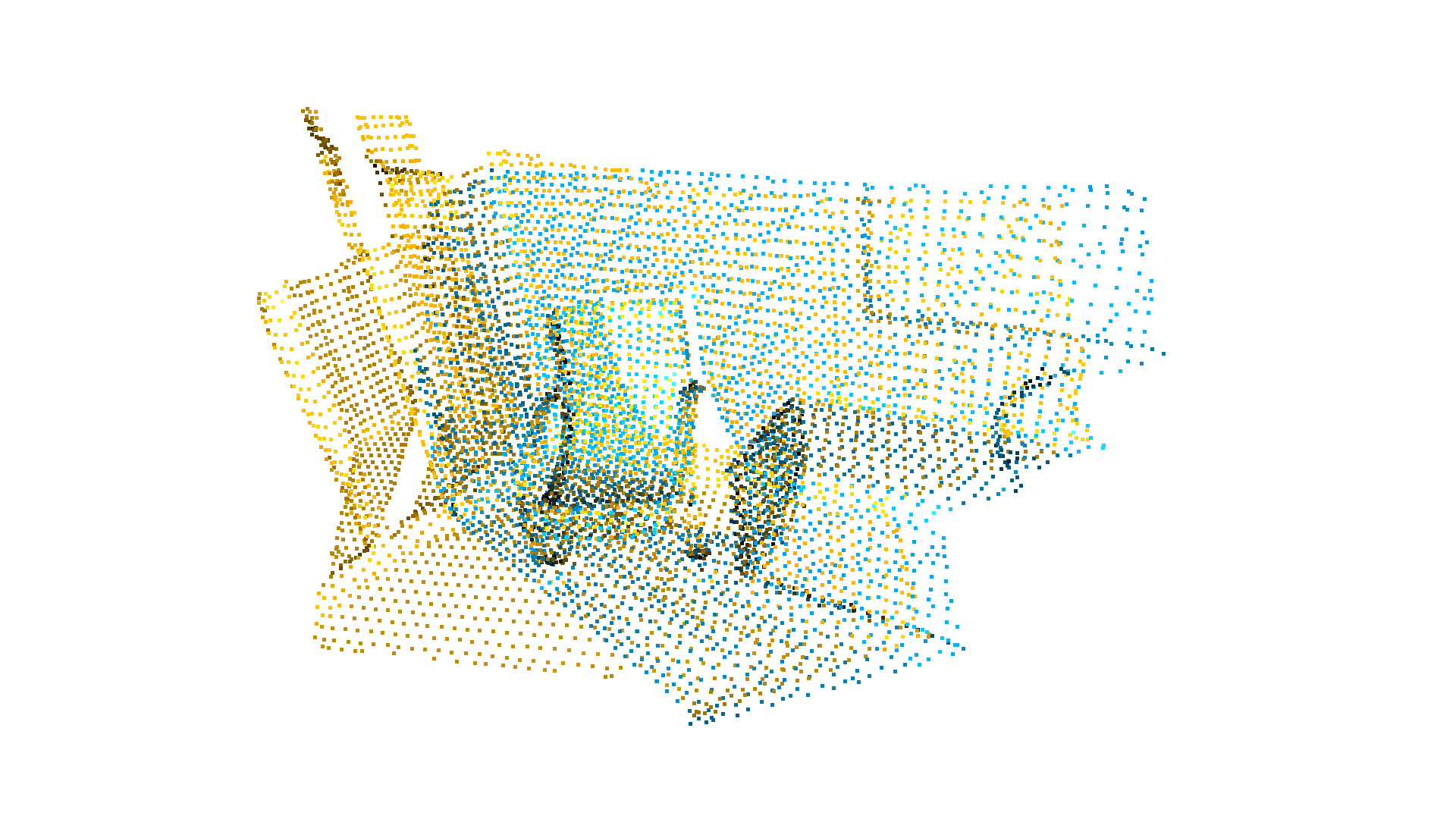
输出:
:: Apply fast global registration with distance threshold 0.025Fast global registration took 0.132 sec.
RegistrationResult with fitness 0.4xxxxxx and correspondence_set size of 2429Access transformation to get result.[Open3D WARNING] GLFW initialized for headless rendering.
经过合理配置后,快速全局配准的精度甚至可与 ICP 相当。更多实验结果请参阅 [Zhou2016]。
除了基于 FPFH 特征的 FGR,还可以通过 registration_fgr_based_on_correspondence 使用基于对应关系的 FGR 来进行全局配准。当你的对应关系前端(correspondence frontend)与 FPFH 不同,但仍希望在一组假定的对应关系上使用 FGR 时,这种方法很有用。其调用方式如下:
o3d.pipelines.registration.registration_fgr_based_on_correspondence( source_down, target_down, correspondence_set, o3d.pipelines.registration.FastGlobalRegistrationOption())