
鲁棒核函数
本教程演示如何在离群点剔除(outlier rejection)场景中使用鲁棒核函数(robust kernels)。在本教程中,我们以 ICP(Iterative Closest Point,迭代最近点)配准算法作为目标问题来处理离群点。尽管如此,这里的理论适用于任意给定的优化问题,而不仅限于 ICP。目前,鲁棒核函数仅针对 PointToPlane ICP 实现了支持。
Open3D 中采用的记号以及部分核函数的实现,灵感来自论文《Analysis of Robust Functions for Registration Algorithms》[Babin2019]。
下面的代码从两个文件中分别读取源点云和目标点云,并给出一个粗略的变换矩阵。
def draw_registration_result(source, target, transformation): source_temp = copy.deepcopy(source) target_temp = copy.deepcopy(target) source_temp.paint_uniform_color([1, 0.706, 0]) target_temp.paint_uniform_color([0, 0.651, 0.929]) source_temp.transform(transformation) o3d.visualization.draw_geometries([source_temp, target_temp], zoom=0.4459, front=[0.9288, -0.2951, -0.2242], lookat=[1.6784, 2.0612, 1.4451], up=[-0.3402, -0.9189, -0.1996])demo_icp_pcds = o3d.data.DemoICPPointClouds()source = o3d.io.read_point_cloud(demo_icp_pcds.paths[0])target = o3d.io.read_point_cloud(demo_icp_pcds.paths[1])trans_init = np.asarray([[0.862, 0.011, -0.507, 0.5], [-0.139, 0.967, -0.215, 0.7], [0.487, 0.255, 0.835, -1.4], [0.0, 0.0, 0.0, 1.0]])draw_registration_result(source, target, trans_init)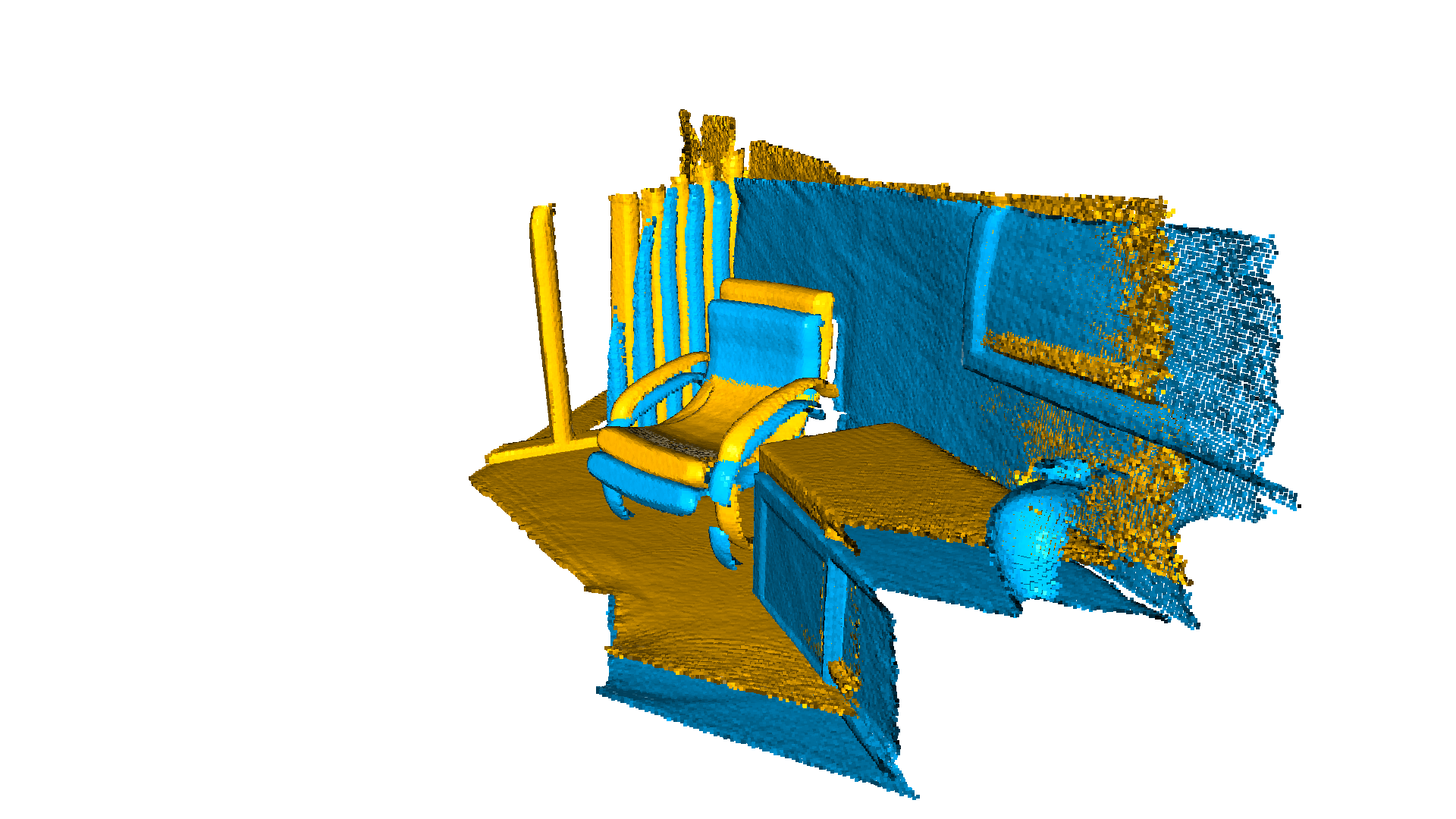
输出:
[Open3D WARNING] GLFW Error: Failed to detect any supported platform[Open3D WARNING] GLFW initialized for headless rendering.使用鲁棒核的 Point-to-plane ICP
Section titled “使用鲁棒核的 Point-to-plane ICP”标准的 point-to-plane ICP 算法 [ChenAndMedioni1992] 最小化如下目标函数:
其中 是点 的法向量, 是目标点云 与源点云 之间的对应关系集合。
若记 为第 个残差,对于给定的一对对应关系 ,可将目标函数改写为:
上述优化问题也可以采用迭代重加权最小二乘(Iteratively Reweighted Least-Squares, IRLS)方法求解,它通过求解一系列加权最小二乘问题来实现:
基于鲁棒核的离群点剔除
Section titled “基于鲁棒核的离群点剔除”鲁棒损失(robust loss)的核心思想是:对那些被认为由离群点产生的大残差进行降权,从而削弱它们对解的影响。这通过对 进行如下优化来实现:
其中 也被称为鲁棒损失函数或核函数(kernel)。
可以看到,IRLS 中的优化形式与采用鲁棒损失函数的形式之间存在某种联系。通过令权重 ,就可以利用现有的加权最小二乘技术来求解鲁棒损失优化问题。因此,我们可以使用 Gauss-Newton 法最小化目标函数,并通过迭代求解下式来确定增量:
其中 是一个对角矩阵,对角元素为每个残差 对应的权重 。
如何在 Open3D 中使用鲁棒核
Section titled “如何在 Open3D 中使用鲁棒核”registration_icp 可以带一个参数 TransformationEstimationPointToPlane(loss) 来调用。其中 loss 是一个给定的损失函数(也称作鲁棒核)。
在内部,TransormationEstimationPointToPlane(loss) 实现了一个函数,用于根据所提供的鲁棒核,计算 point-to-plane ICP 目标的加权残差和雅可比矩阵。
普通 ICP 与鲁棒 ICP 的对比
Section titled “普通 ICP 与鲁棒 ICP 的对比”为了更好地展示在配准中使用鲁棒核的优势,我们人为地向源点云添加一些高斯噪声。
def apply_noise(pcd, mu, sigma):    noisy_pcd = copy.deepcopy(pcd)    points = np.asarray(noisy_pcd.points)    points += np.random.normal(mu, sigma, size=points.shape)    noisy_pcd.points = o3d.utility.Vector3dVector(points)    return noisy_pcd

mu, sigma = 0, 0.1  # mean and standard deviationsource_noisy = apply_noise(source, mu, sigma)
print("Source PointCloud + noise:")o3d.visualization.draw_geometries([source_noisy],                                  zoom=0.4459,                                  front=[0.353, -0.469, -0.809],                                  lookat=[2.343, 2.217, 1.809],                                  up=[-0.097, -0.879, 0.467])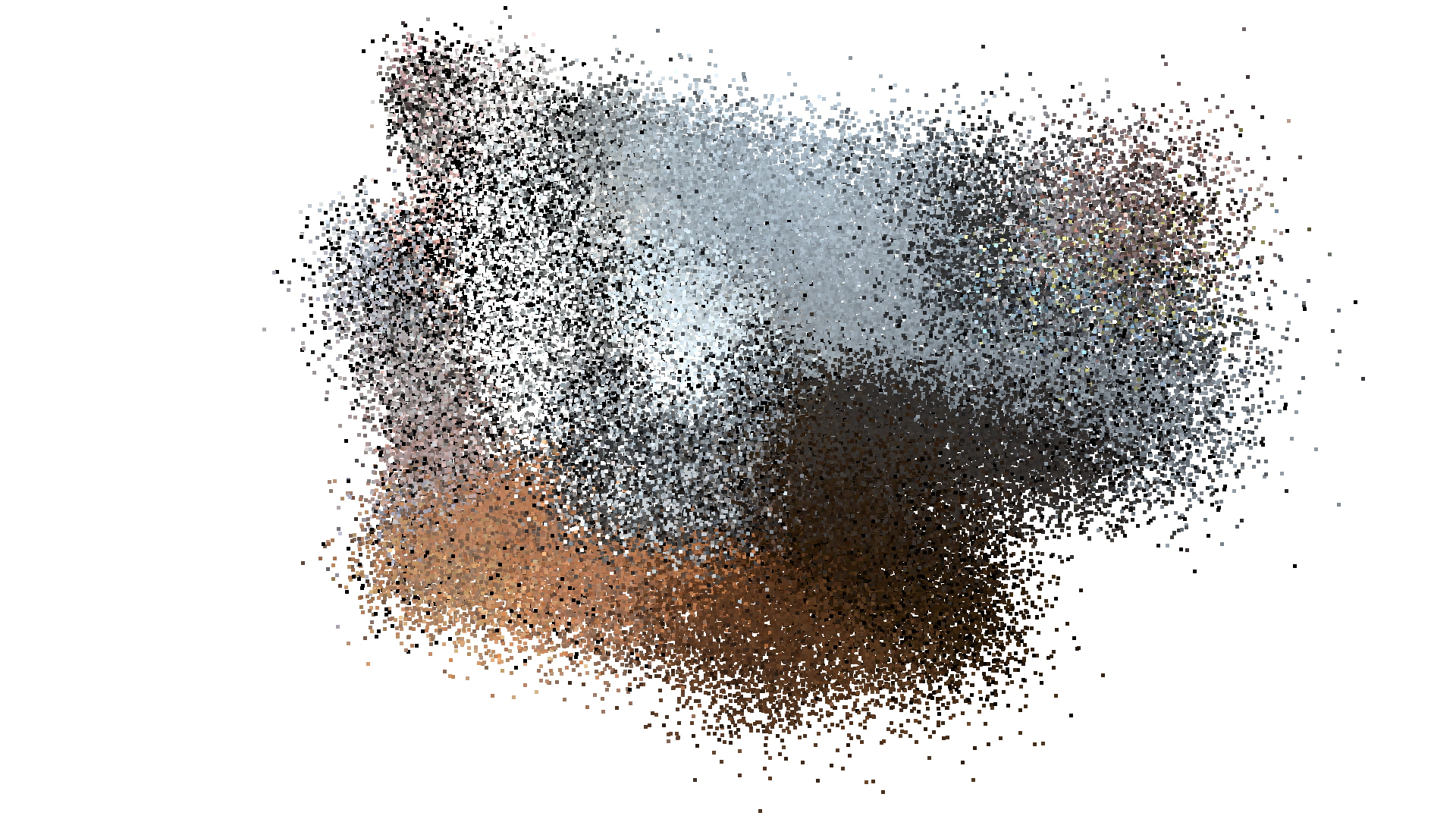
输出:
Source PointCloud + noise:[Open3D WARNING] GLFW initialized for headless rendering.普通 ICP
Section titled “普通 ICP”我们来看看,如果直接沿用 ICP 配准教程中使用过的完全相同参数,结果会怎样。
threshold = 0.02print("Vanilla point-to-plane ICP, threshold {}: {}".format(threshold))p2l = o3d.pipelines.registration.TransformationEstimationPointToPlane()reg_p2l = o3d.pipelines.registration.registration_icp(source_noisy, target,                                                      threshold, trans_init,                                                      p2l)
print(reg_p2l)print("Transformation is:")print(reg_p2l.transformation)draw_registration_result(source, target, reg_p2l.transformation)
输出:
Vanilla point-to-plane ICP,RegistrationResult with fitness 0.1xxxx and correspondence_set size of 19921Access transformation to get result.Transformation is:[[ 0.8566005 0.01966479 -0.51582045 0.50097926] [-0.15647173 0.96255541 -0.22285079 0.78844504] [ 0.4912089 0.27080504 0.82750577 -1.43586132] [ 0. 0. 0. 1. ]][Open3D WARNING] GLFW initialized for headless rendering.调参普通 ICP
Section titled “调参普通 ICP”既然我们现在面对的是高斯噪声,我们或许可以尝试增大阈值来搜索最近邻,以期改善配准结果。
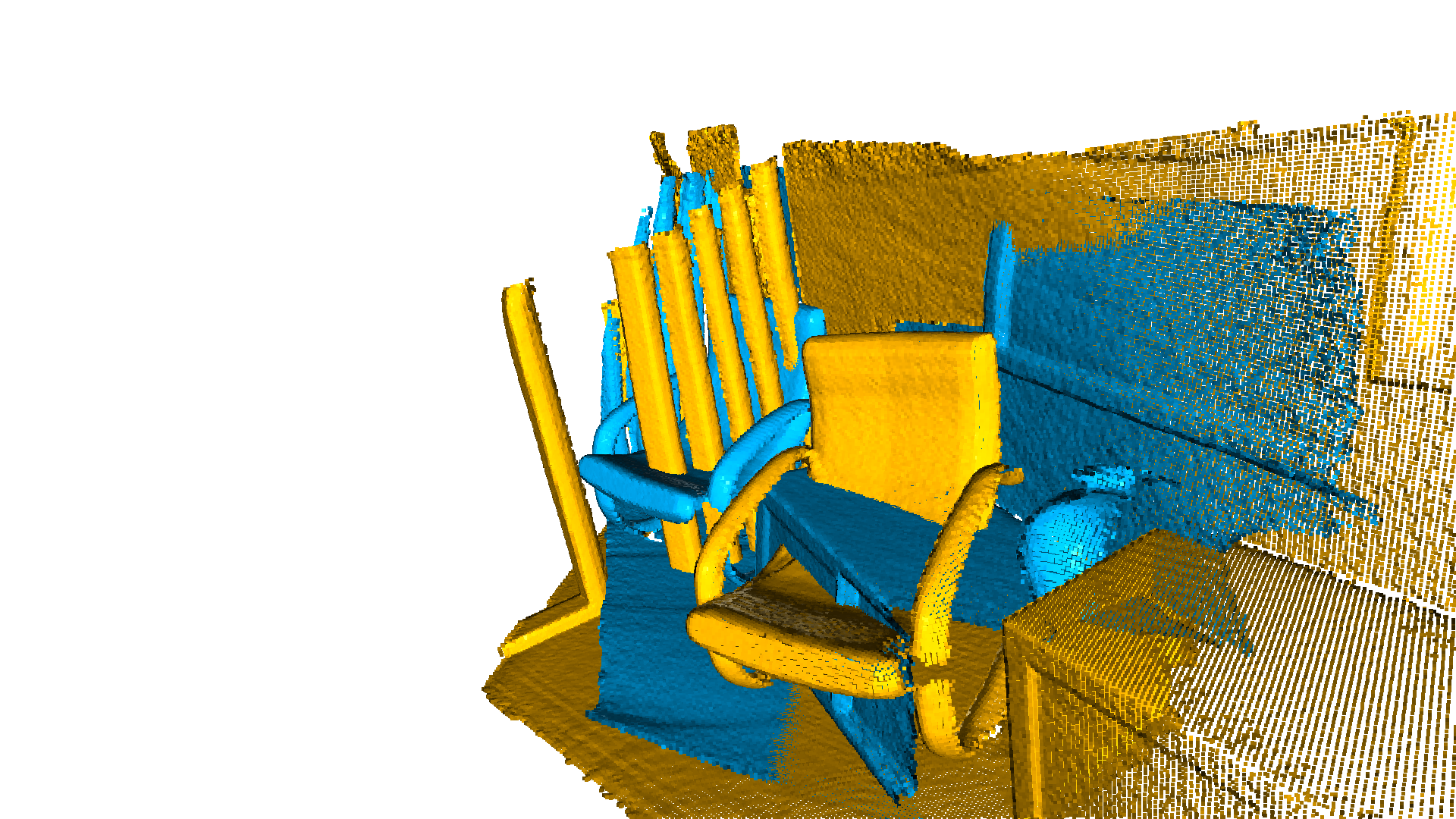
可以看到,在这样的条件下且不使用鲁棒核时,传统 ICP 完全无法处理离群点。
threshold = 1.0print("Vanilla point-to-plane ICP, threshold {}: {}".format(threshold))p2l = o3d.pipelines.registration.TransformationEstimationPointToPlane()reg_p2l = o3d.pipelines.registration.registration_icp(source_noisy, target,                                                      threshold, trans_init,                                                      p2l)
print(reg_p2l)print("Transformation is:")print(reg_p2l.transformation)draw_registration_result(source, target, reg_p2l.transformation)
输出:
Vanilla point-to-plane ICP,RegistrationResult with fitness 0.1xxxx and correspondence_set size of 198835Access transformation to get result.Transformation is:[[ 0.79176699 0.06858295 -0.60724278 1.53567654] [-0.29950932 0.91009785 -0.28778649 1.26588549] [ 0.53191466 0.40896612 0.7409009 -1.47497048] [ 0. 0. 0. 1. ]][Open3D WARNING] GLFW initialized for headless rendering.鲁棒 ICP
Section titled “鲁棒 ICP”使用相同的 threshold=1.0,并配合一个鲁棒核,就能正确地把两个点云配准起来:
print("Robust point-to-plane ICP, threshold {}: {}".format(threshold))loss = o3d.pipelines.registration.TukeyLoss(k=sigma)print("Using robust loss:", loss)p2l = o3d.pipelines.registration.TransformationEstimationPointToPlane(loss)reg_p2l = o3d.pipelines.registration.registration_icp(source_noisy, target, threshold, trans_init, p2l)print(reg_p2l)print("Transformation is:")print(reg_p2l.transformation)draw_registration_result(source, target, reg_p2l.transformation)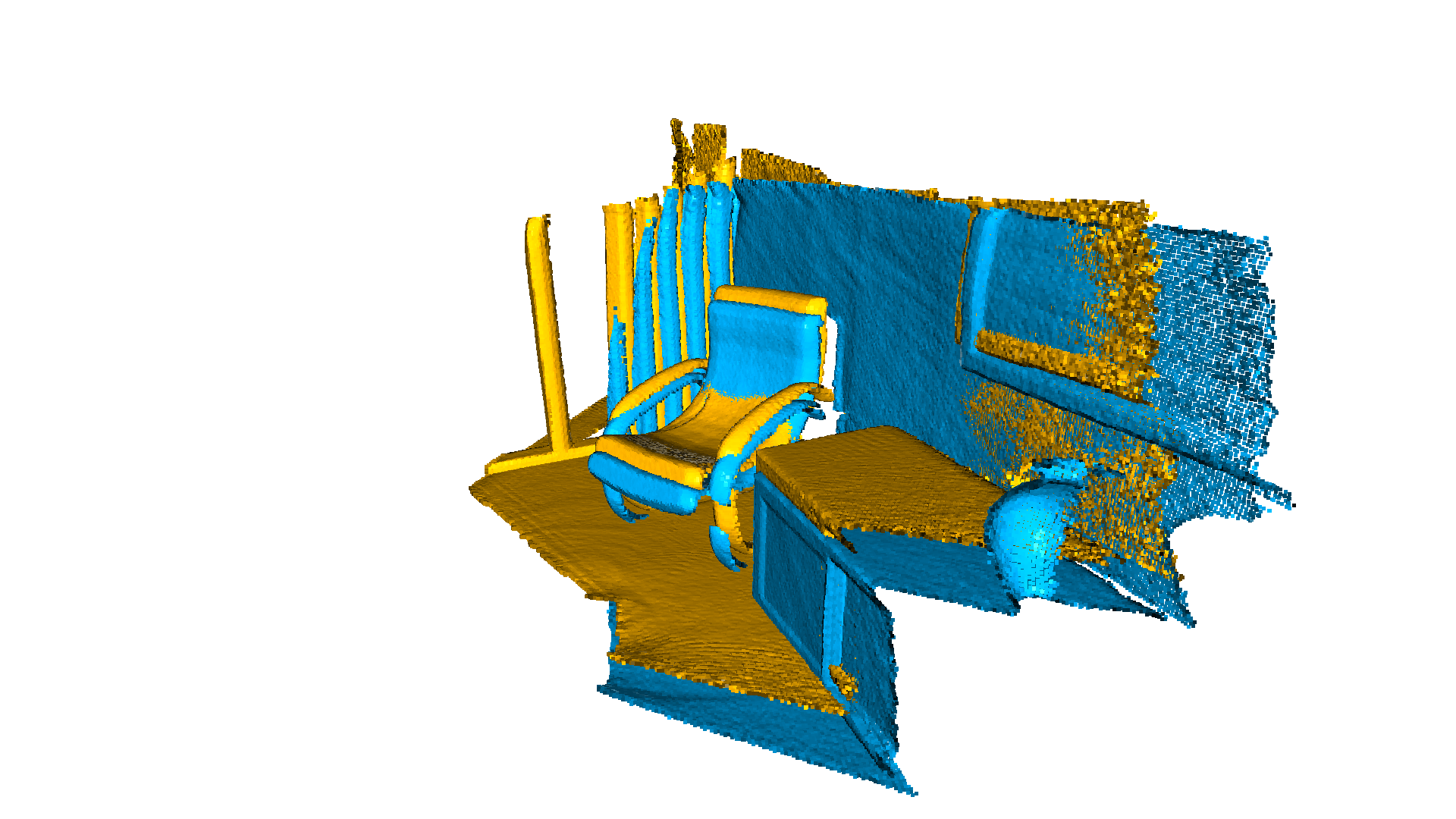
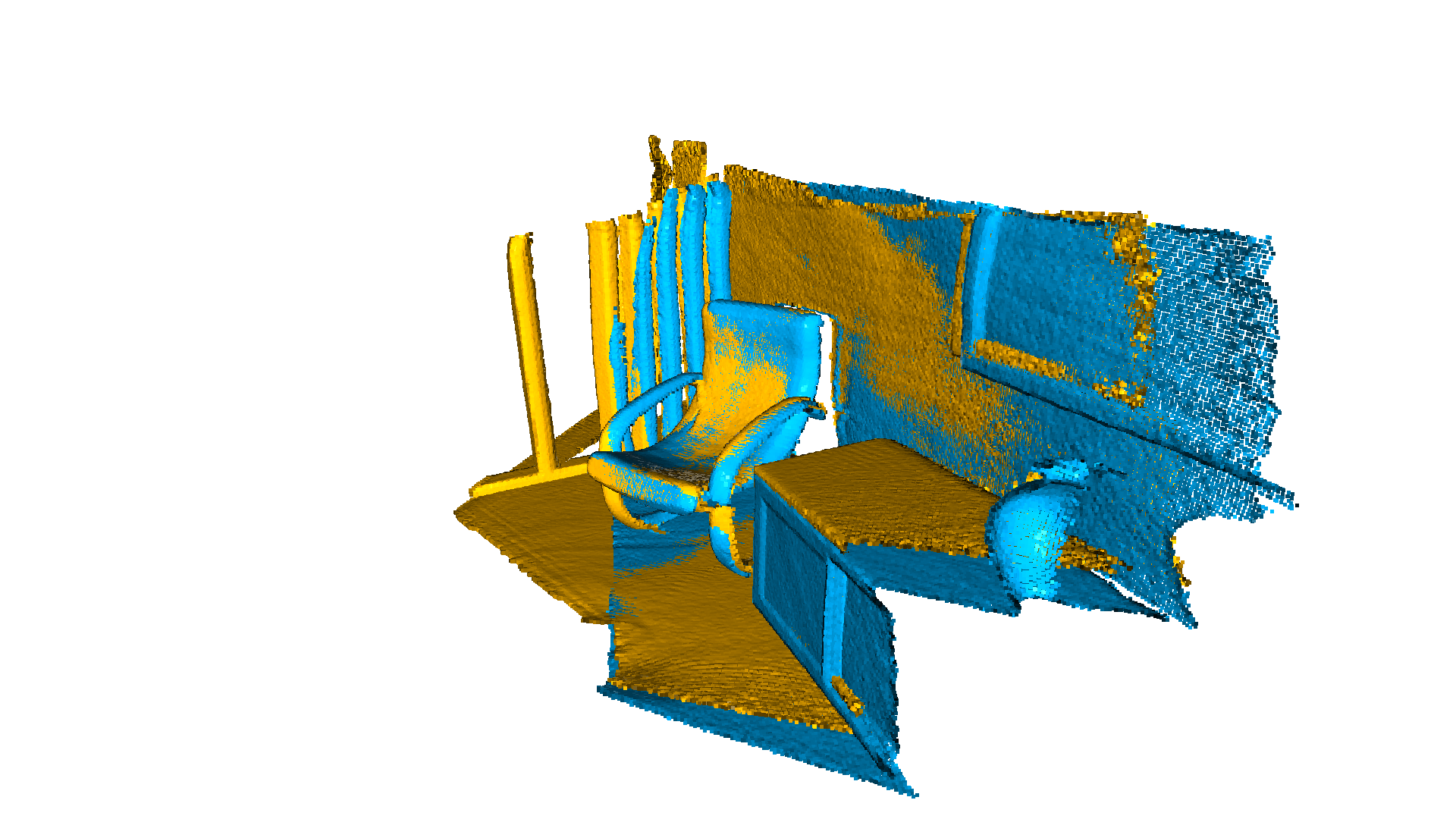
输出:
Robust point-to-plane ICP,Using robust loss: RobustKernel::TukeyLoss with k=0.100000RegistrationResult with fitness 0.1xxxx and correspondence_set size of 186041Access transformation to get result.Transformation is:[[ 0.83218598 0.04077245 -0.55323816 0.59712462] [-0.18678854 0.96004183 -0.21000923 0.90890328] [ 0.52164216 0.27729459 0.80642585 -1.51385962] [ 0. 0. 0. 1. ]][Open3D WARNING] GLFW initialized for headless rendering.