
体素化
点云和三角网格是非常灵活、但不规则的几何类型。体素网格(voxel grid)是三维中的另一种几何类型,它定义在规则的三维网格上,其中一个体素(voxel)可以看作二维像素在三维中的对应物。Open3D 提供了 VoxelGrid 这一几何类型,可用于处理体素网格。
从三角网格生成
Section titled “从三角网格生成”Open3D 提供了 create_from_triangle_mesh 方法,可由三角网格创建体素网格。它返回一个体素网格,其中所有与某个三角形相交的体素都被置为 1,其余均为 0。参数 voxel_size 定义了体素网格的分辨率。
print('input')bunny = o3d.data.BunnyMesh()mesh = o3d.io.read_triangle_mesh(bunny.path)
# fit to unit cubemesh.scale(1 / np.max(mesh.get_max_bound() - mesh.get_min_bound()),           center=mesh.get_center())o3d.visualization.draw_geometries([mesh])
print('voxelization')voxel_grid = o3d.geometry.VoxelGrid.create_from_triangle_mesh(mesh,                                                              voxel_size=0.05)o3d.visualization.draw_geometries([voxel_grid])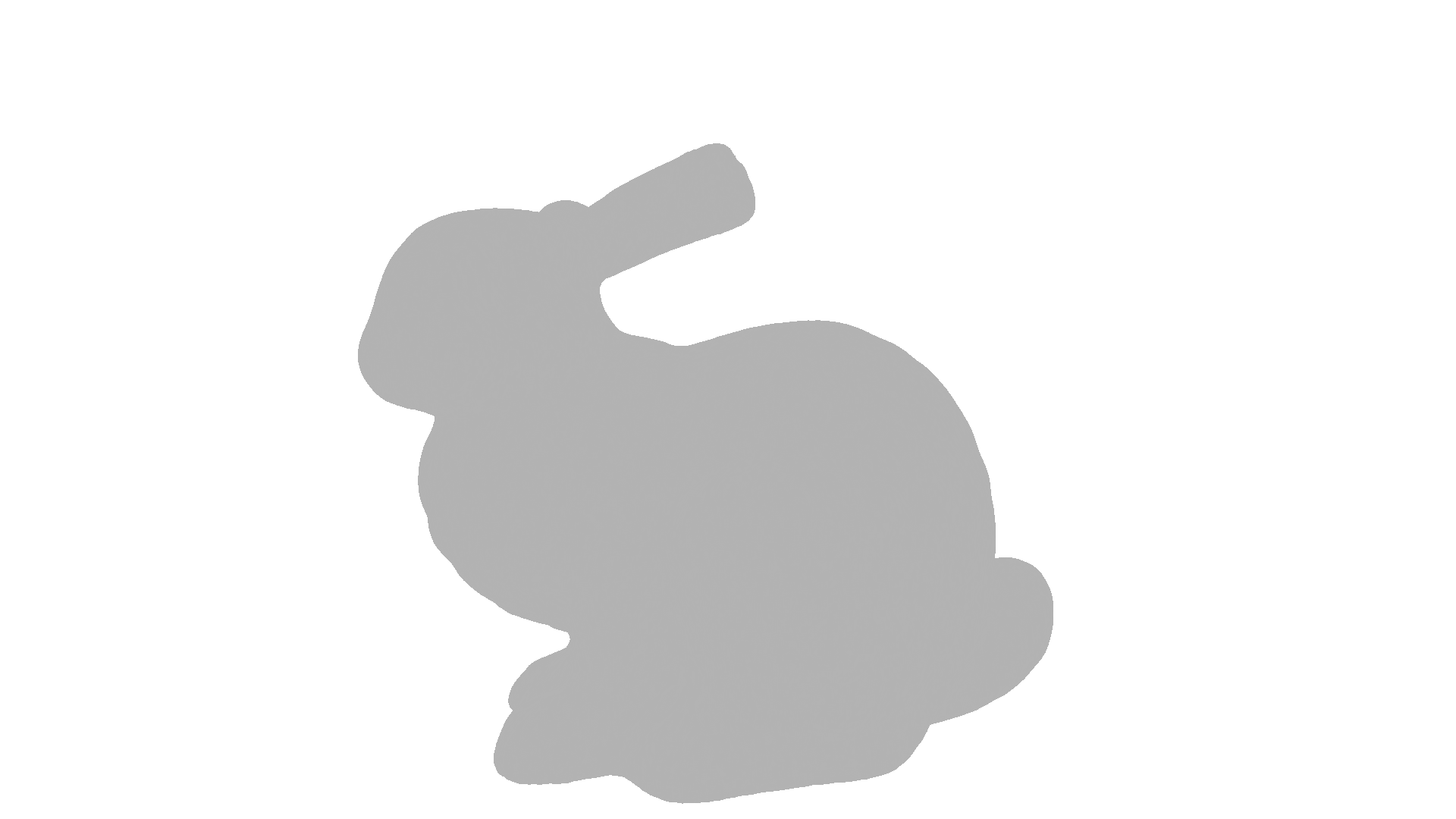
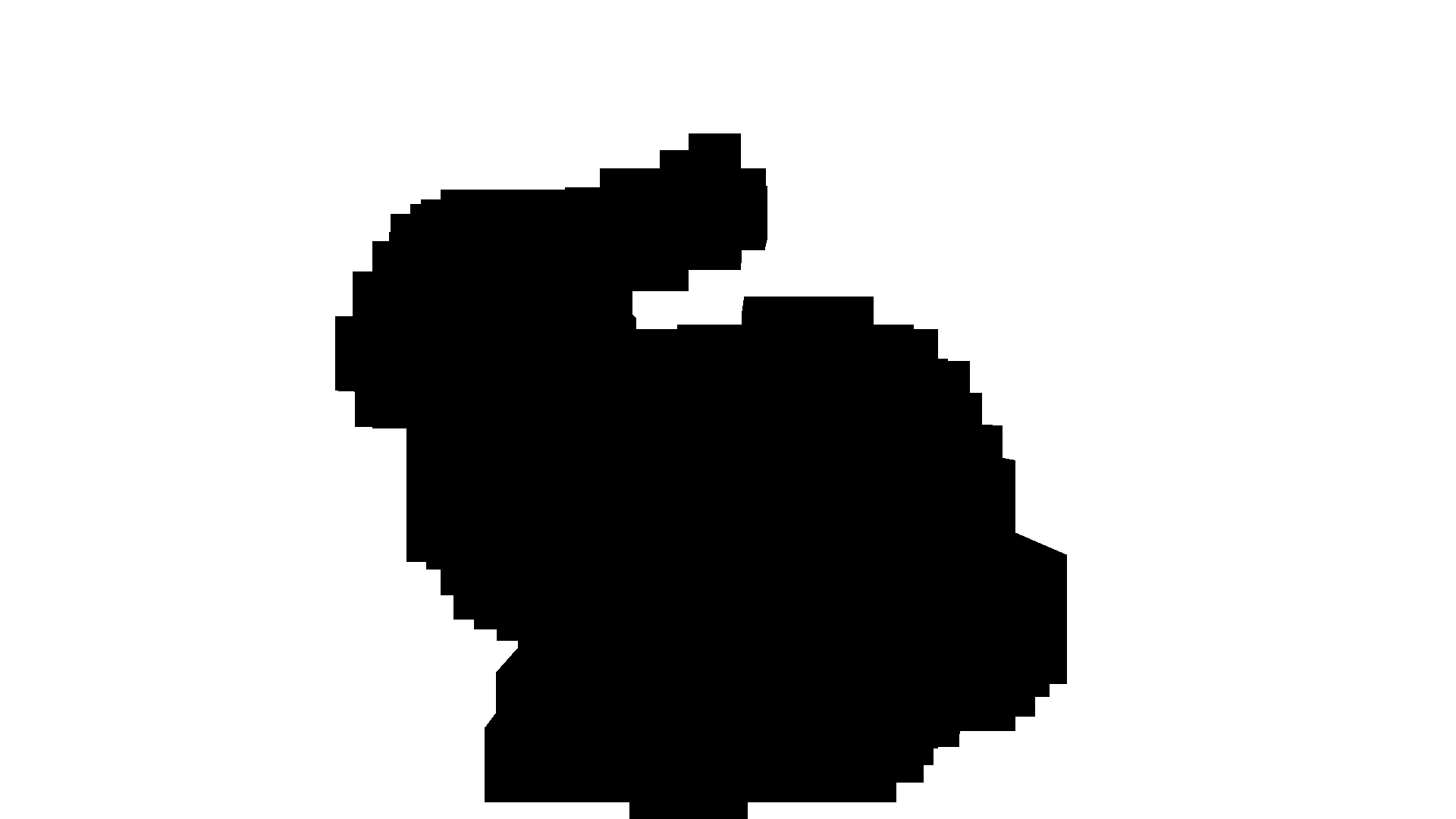
输出:
inputvoxelization也可以使用 create_from_point_cloud 方法由点云创建体素网格。只要点云中至少有一个点落在某个体素内,该体素即被视为被占据。参数 voxel_size 定义了体素网格的分辨率。默认情况下,体素的颜色为其内部所有点颜色的平均值。可以通过修改 pooling_mode 参数,按点的均值、最小值、最大值或求和值来确定颜色,例如:
o3d.geometry.VoxelGrid.VoxelPoolingMode.MINprint('input')armadillo = o3d.data.ArmadilloMesh()mesh = o3d.io.read_triangle_mesh(armadillo.path)
N = 2000pcd = mesh.sample_points_poisson_disk(N)# fit to unit cubepcd.scale(1 / np.max(pcd.get_max_bound() - pcd.get_min_bound()), center=pcd.get_center())pcd.colors = o3d.utility.Vector3dVector(np.random.uniform(0, 1, size=(N, 3)))o3d.visualization.draw_geometries([pcd])
print('voxelization')voxel_grid = o3d.geometry.VoxelGrid.create_from_point_cloud(pcd, voxel_size=0.05)o3d.visualization.draw_geometries([voxel_grid])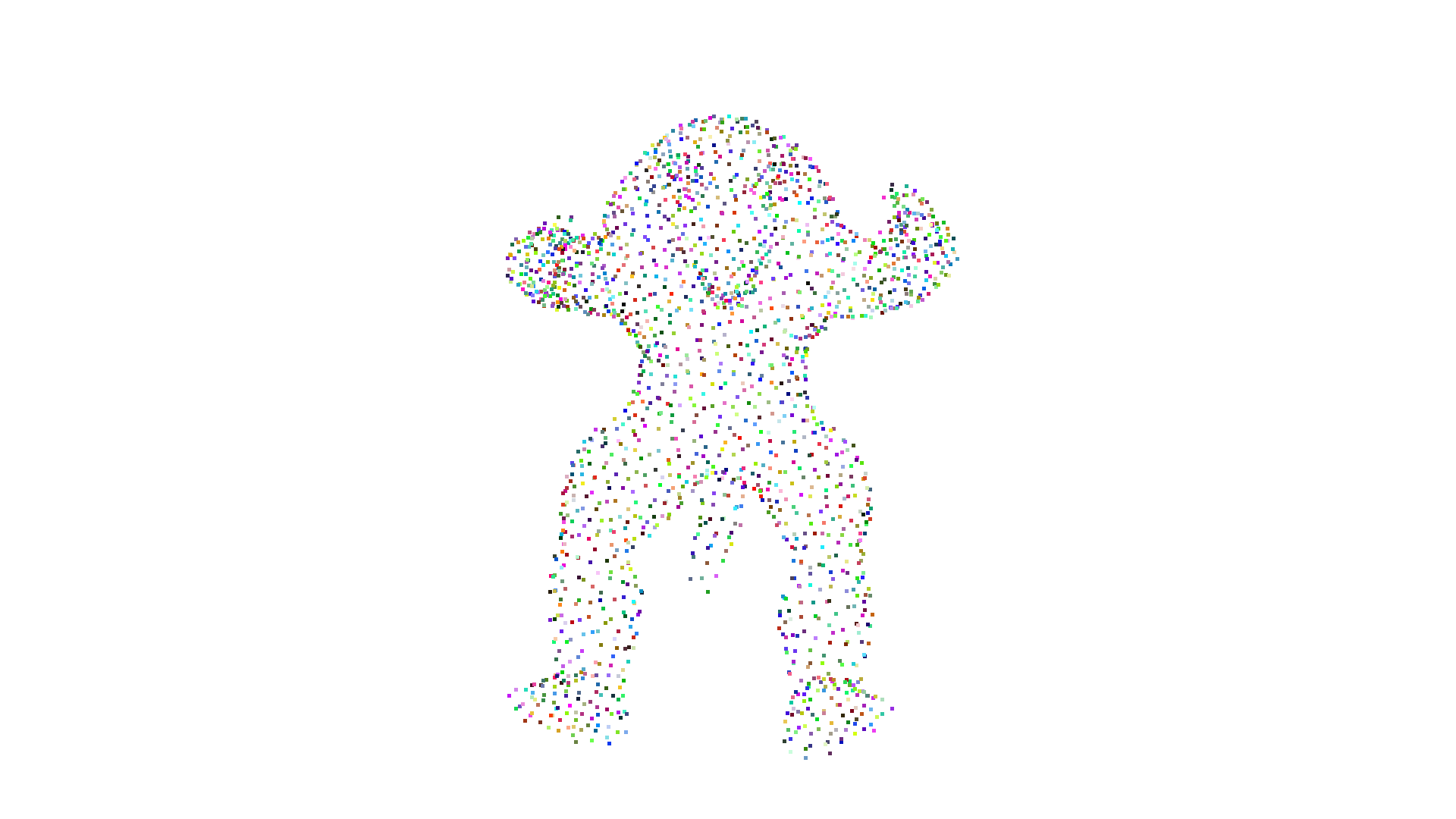
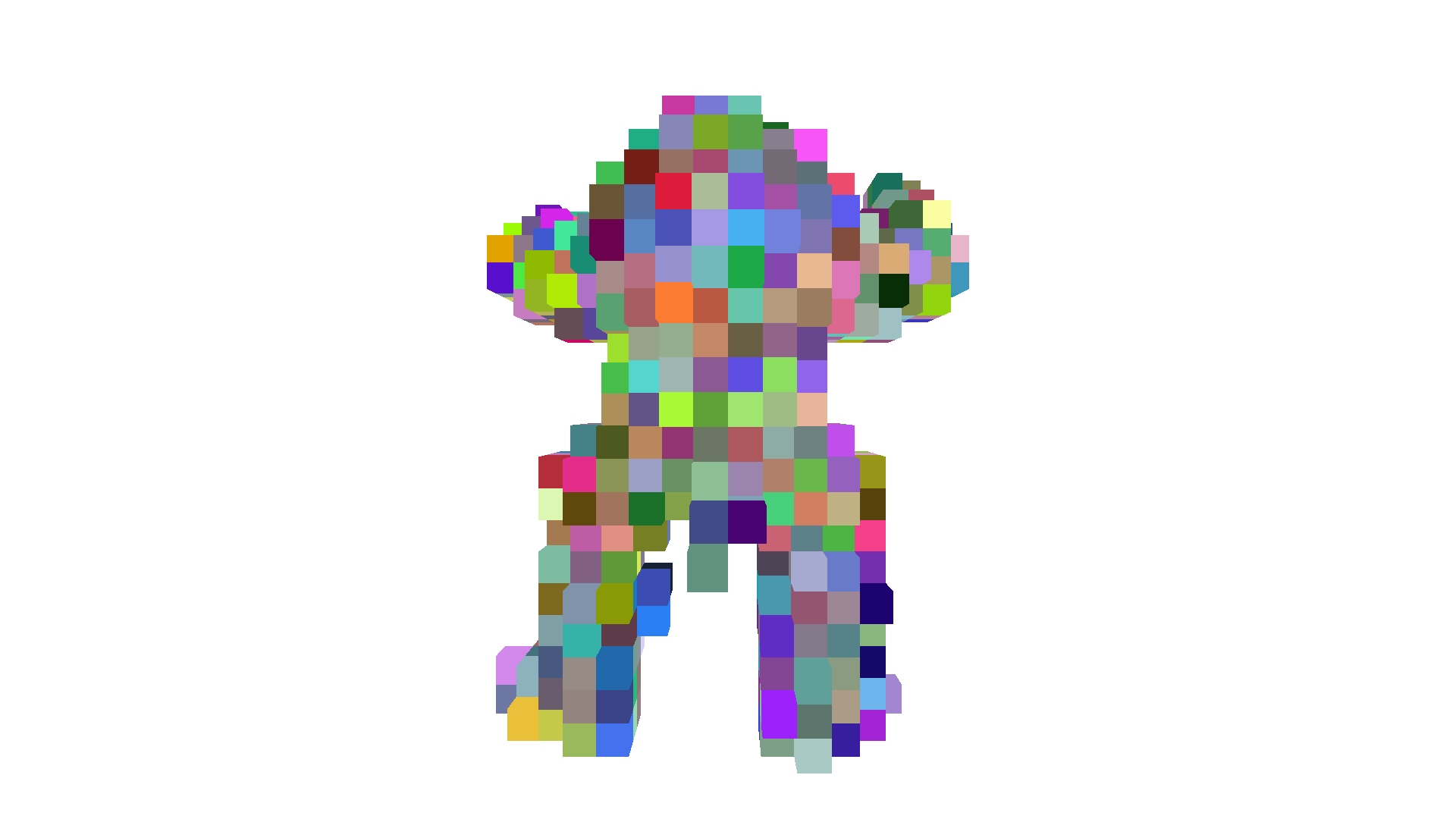
输出:
inputvoxelization体素网格还可用于测试某些点是否位于被占据的体素内。check_if_included 方法接收一个 (n, 3) 数组作为输入,并输出一个布尔数组。
queries = np.asarray(pcd.points)output = voxel_grid.check_if_included(o3d.utility.Vector3dVector(queries))print(output[:10])输出:
[True, True, True, True, True, True, True, True, True, True]create_from_point_cloud 和 create_from_triangle_mesh 方法只会在几何体的表面创建被占据的体素。不过,也可以从若干深度图(depth maps)或剪影(silhouettes)中雕刻出一个体素网格。Open3D 提供了 carve_depth_map 和 carve_silhouette 方法用于体素雕刻(voxel carving)。
下面的代码先对一个几何体渲染出多幅深度图,再用这些深度图去雕刻一个稠密的体素网格,从而演示上述用法。最终结果是给定形状的一个填充体素网格。
def xyz_spherical(xyz):    x = xyz[0]    y = xyz[1]    z = xyz[2]    r = np.sqrt(x * x + y * y + z * z)    r_x = np.arccos(y / r)    r_y = np.arctan2(z, x)    return [r, r_x, r_y]

def get_rotation_matrix(r_x, r_y):    rot_x = np.asarray([[1, 0, 0], [0, np.cos(r_x), -np.sin(r_x)],                        [0, np.sin(r_x), np.cos(r_x)]])    rot_y = np.asarray([[np.cos(r_y), 0, np.sin(r_y)], [0, 1, 0],                        [-np.sin(r_y), 0, np.cos(r_y)]])    return rot_y.dot(rot_x)

def get_extrinsic(xyz):    rvec = xyz_spherical(xyz)    r = get_rotation_matrix(rvec[1], rvec[2])    t = np.asarray([0, 0, 2]).transpose()    trans = np.eye(4)    trans[:3, :3] = r    trans[:3, 3] = t    return trans

def preprocess(model):    min_bound = model.get_min_bound()    max_bound = model.get_max_bound()    center = min_bound + (max_bound - min_bound) / 2.0    scale = np.linalg.norm(max_bound - min_bound) / 2.0    vertices = np.asarray(model.vertices)    vertices -= center    model.vertices = o3d.utility.Vector3dVector(vertices / scale)    return model

def voxel_carving(mesh,                  cubic_size,                  voxel_resolution,                  w=300,                  h=300,                  use_depth=True,                  surface_method='pointcloud'):    mesh.compute_vertex_normals()    camera_sphere = o3d.geometry.TriangleMesh.create_sphere()
    # setup dense voxel grid    voxel_carving = o3d.geometry.VoxelGrid.create_dense(        width=cubic_size,        height=cubic_size,        depth=cubic_size,        voxel_size=cubic_size / voxel_resolution,        origin=[-cubic_size / 2.0, -cubic_size / 2.0, -cubic_size / 2.0],        color=[1.0, 0.7, 0.0])
    # rescale geometry    camera_sphere = preprocess(camera_sphere)    mesh = preprocess(mesh)
    # setup visualizer to render depthmaps    vis = o3d.visualization.Visualizer()    vis.create_window(width=w, height=h, visible=False)    vis.add_geometry(mesh)    vis.get_render_option().mesh_show_back_face = True    ctr = vis.get_view_control()    param = ctr.convert_to_pinhole_camera_parameters()
    # carve voxel grid    pcd_agg = o3d.geometry.PointCloud()    centers_pts = np.zeros((len(camera_sphere.vertices), 3))    for cid, xyz in enumerate(camera_sphere.vertices):        # get new camera pose        trans = get_extrinsic(xyz)        param.extrinsic = trans        c = np.linalg.inv(trans).dot(np.asarray([0, 0, 0, 1]).transpose())        centers_pts[cid, :] = c[:3]        ctr.convert_from_pinhole_camera_parameters(param)
        # capture depth image and make a point cloud        vis.poll_events()        vis.update_renderer()        depth = vis.capture_depth_float_buffer(False)        pcd_agg += o3d.geometry.PointCloud.create_from_depth_image(            o3d.geometry.Image(depth),            param.intrinsic,            param.extrinsic,            depth_scale=1)
        # depth map carving method        if use_depth:            voxel_carving.carve_depth_map(o3d.geometry.Image(depth), param)        else:            voxel_carving.carve_silhouette(o3d.geometry.Image(depth), param)        print("Carve view %03d/%03d" % (cid + 1, len(camera_sphere.vertices)))    vis.destroy_window()
    # add voxel grid survace    print('Surface voxel grid from %s' % surface_method)    if surface_method == 'pointcloud':        voxel_surface = o3d.geometry.VoxelGrid.create_from_point_cloud_within_bounds(            pcd_agg,            voxel_size=cubic_size / voxel_resolution,            min_bound=(-cubic_size / 2, -cubic_size / 2, -cubic_size / 2),            max_bound=(cubic_size / 2, cubic_size / 2, cubic_size / 2))    elif surface_method == 'mesh':        voxel_surface = o3d.geometry.VoxelGrid.create_from_triangle_mesh_within_bounds(            mesh,            voxel_size=cubic_size / voxel_resolution,            min_bound=(-cubic_size / 2, -cubic_size / 2, -cubic_size / 2),            max_bound=(cubic_size / 2, cubic_size / 2, cubic_size / 2))    else:        raise Exception('invalid surface method')    voxel_carving_surface = voxel_surface + voxel_carving
    return voxel_carving_surface, voxel_carving, voxel_surface
armadillo = o3d.data.ArmadilloMesh()mesh = o3d.io.read_triangle_mesh(armadillo.path)
visualization = Truecubic_size = 2.0voxel_resolution = 128.0
voxel_grid, voxel_carving, voxel_surface = voxel_carving( mesh, cubic_size, voxel_resolution)输出(雕刻过程共遍历 762 个视角,此处省略重复的进度日志):
Carve view 001/762Carve view 002/762...Carve view 762/762Surface voxel grid from pointcloudprint("surface voxels")print(voxel_surface)o3d.visualization.draw_geometries([voxel_surface])
print("carved voxels")print(voxel_carving)o3d.visualization.draw_geometries([voxel_carving])
print("combined voxels (carved + surface)")print(voxel_grid)o3d.visualization.draw_geometries([voxel_grid])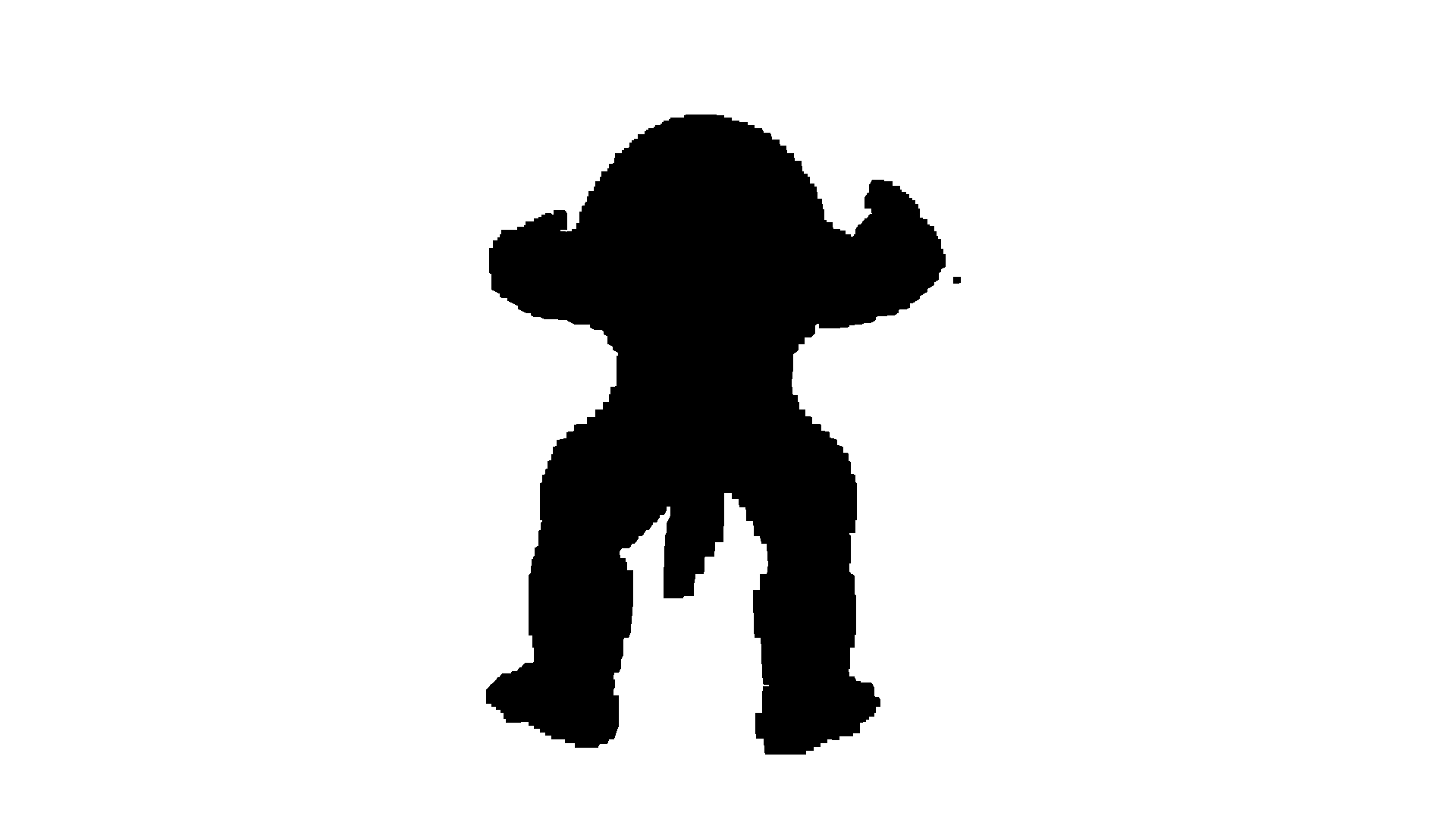
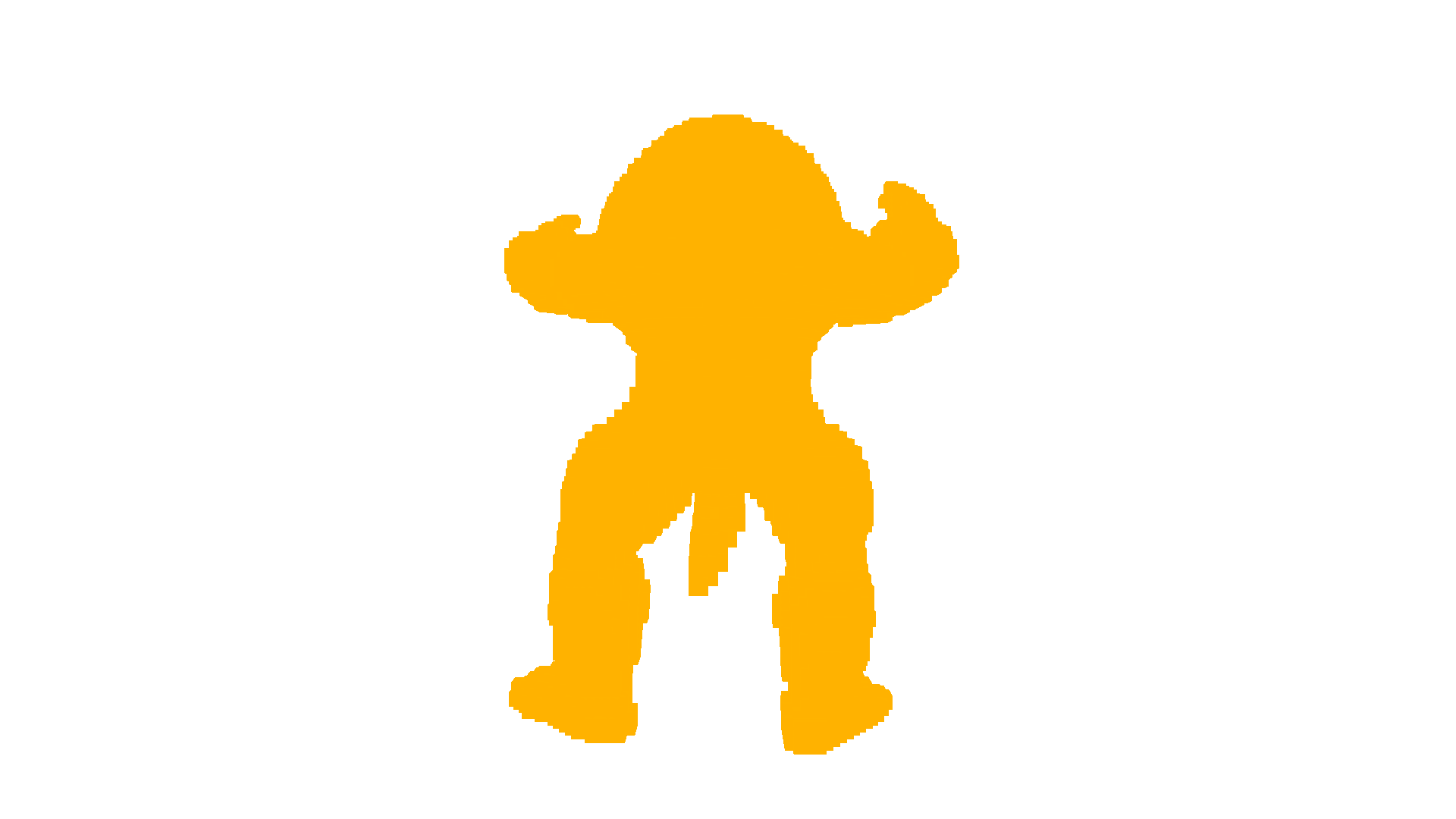
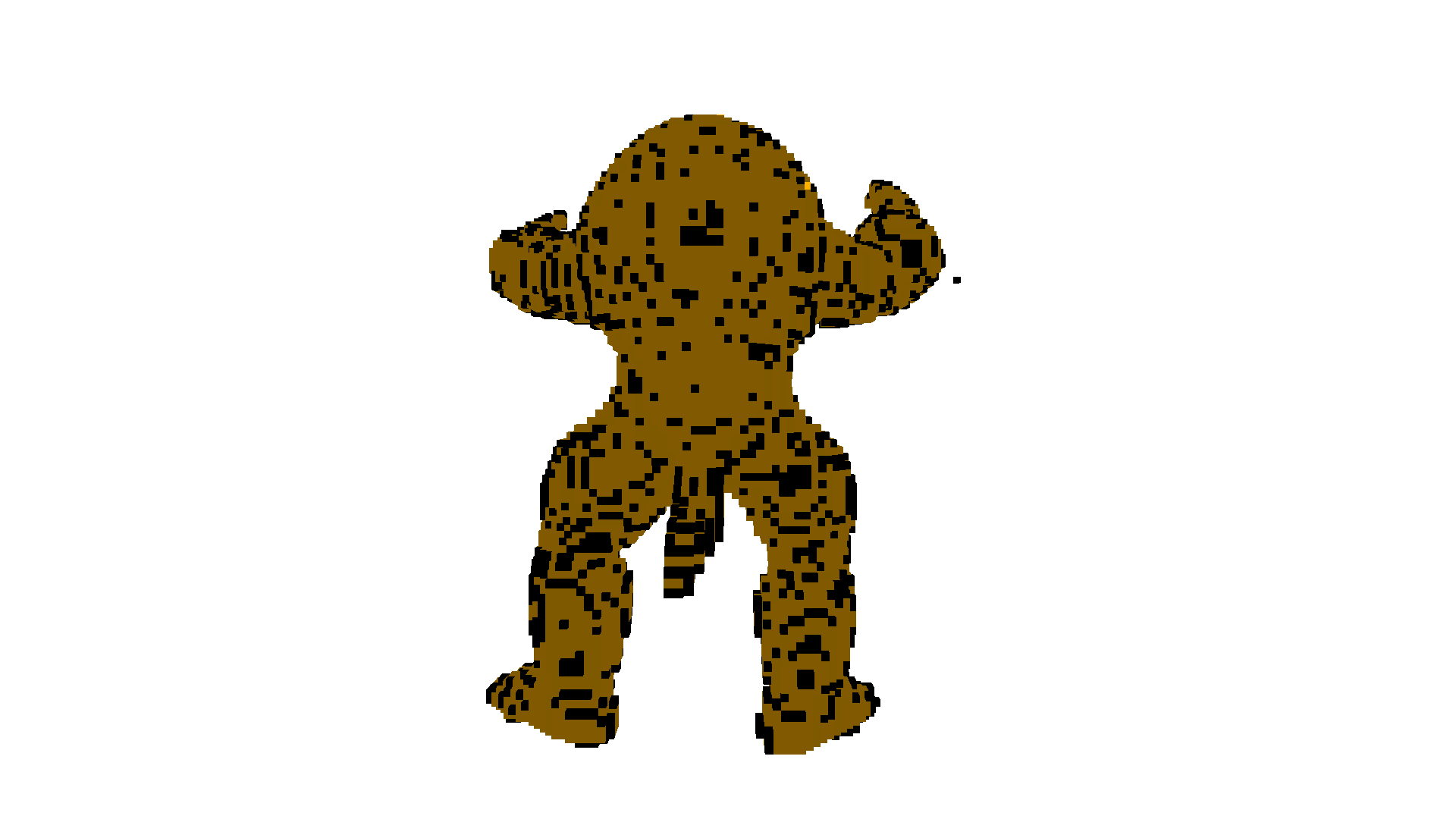
输出:
surface voxelsVoxelGrid with 17219 voxels.carved voxelsVoxelGrid with 48379 voxels.combined voxels (carved + surface)VoxelGrid with 50793 voxels.